A list of my publications in reverse chronological order. For a complete and continuously updated record, see INSPIRE-HEP or arXiv.
2026
[20]
Enabling gravitational-wave astronomy with spin-precessing black holes on generic orbits
Aldo Gamboa, Lorenzo Pompili, Alessandra Buonanno et al.
[19]★
Joint inference of line-of-sight acceleration and orbital eccentricity in neutron star black hole binaries
Lorenzo Pompili, Aldo Gamboa, Alessandra Buonanno
[18]★
Eccentric and unbound compact binaries in the LIGO-Virgo-KAGRA catalog: parameter estimation and waveform systematics with SEOBNRv6EHM
Lorenzo Pompili, Aldo Gamboa, Alessandra Buonanno
[17]
Accurate waveforms for generic planar-orbit binary black holes: The multipolar effective-one-body model SEOBNRv6EHM
Aldo Gamboa, Alessandra Buonanno, Lorenzo Pompili et al.
[16]ApJ
Eccentricity constraints disfavor single-single capture in nuclear star clusters as the origin of all LIGO-Virgo-KAGRA binary black holes
Nihar Gupte et al. (inc. Lorenzo Pompili)
[15]PRD
Plunge–Merger–Ringdown Tests of General Relativity with GW250114
Leonardo Grimaldi, Elisa Maggio, Lorenzo Pompili, Alessandra Buonanno
2025
[14]PRD
Incorporating antisymmetric multipoles for spin-precessing binary signals into the SEOBNR framework
Héctor Estellés, Alessandra Buonanno, Raffi Enficiaud, Cheng Foo, Lorenzo Pompili
[13]★PRD
A parametrized spin-precessing inspiral-merger-ringdown waveform model for tests of general relativity
Lorenzo Pompili, Elisa Maggio, Hector O. Silva, Alessandra Buonanno
[12]CQG
Impact of eccentricity and mean anomaly in numerical relativity mergers
Peter James Nee et al. (inc. Lorenzo Pompili)
2024
[11]PRD
Accurate waveforms for eccentric, aligned-spin binary black holes: The multipolar effective-one-body model SEOBNRv5EHM
Aldo Gamboa et al. (inc. Lorenzo Pompili)
[10]★PRD
Accounting for Numerical-Relativity Calibration Uncertainty in Gravitational-Wave Modeling and Inference
Lorenzo Pompili, Alessandra Buonanno, Michael Pürrer
[9]★PRD
Inspiral-merger-ringdown waveforms in Einstein-scalar-Gauss-Bonnet gravity within the effective-one-body formalism
Félix-Louis Julié, Lorenzo Pompili, Alessandra Buonanno
[8]∗∗PRL
Post-Minkowskian Theory Meets the Spinning Effective-One-Body Approach for Bound-Orbit Waveforms
Alessandra Buonanno, Gustav Mogull, Raj Patil, Lorenzo Pompili
[7]PRX
Systematic Biases in Estimating the Properties of Black Holes Due to Inaccurate Gravitational-Wave Models
Arnab Dhani et al. (inc. Lorenzo Pompili)
2023
[6]PRD
Measuring source properties and quasi-normal-mode frequencies of heavy massive black-hole binaries with LISA
Alexandre Toubiana, Lorenzo Pompili et al.
[5]SoftwareX
pySEOBNR: a software package for the next generation of effective-one-body multipolar waveform models
Deyan P. Mihaylov et al. (inc. Lorenzo Pompili)
[4]PRD
Enhancing the SEOBNRv5 effective-one-body waveform model with second-order gravitational self-force fluxes
Maarten van de Meent et al. (inc. Lorenzo Pompili)
[3]PRD
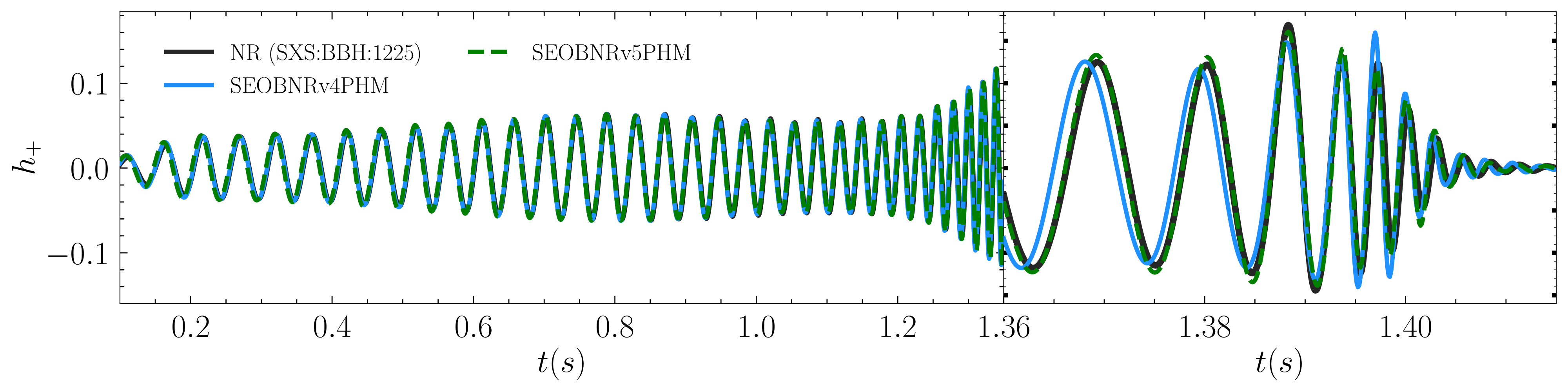
SEOBNRv5PHM: Next generation of accurate and efficient multipolar precessing-spin effective-one-body waveforms for binary black holes
Antoni Ramos-Buades et al. (inc. Lorenzo Pompili)
[2]PRD
Theoretical groundwork supporting the precessing-spin two-body dynamics of the effective-one-body waveform models SEOBNRv5
Mohammed Khalil et al. (inc. Lorenzo Pompili)
[1]★PRD
Laying the foundation of the effective-one-body waveform models SEOBNRv5: improved accuracy and efficiency for spinning non-precessing binary black holes
Lorenzo Pompili et al.
As a member of the LIGO Scientific Collaboration, I am a co-author on many full-collaboration papers; see INSPIRE for a complete list. Highlighted below are those to which I made a direct personal contribution. Papers for which I was part of the LIGO–Virgo–KAGRA Editorial Team are marked with ★.
2026
[17]★
GWTC-5.0: Tests of General Relativity
LIGO-Virgo-KAGRA Collaboration (inc. Lorenzo Pompili)
[16]
GWTC-5.0: Observations from the Second Part of the Fourth LIGO-Virgo-KAGRA Observing Run and Updates to the Gravitational-Wave Transient Catalog
LIGO-Virgo-KAGRA Collaboration (inc. Lorenzo Pompili)
[15]PRL
GW240925 and GW250207: Astrophysical Calibration of Gravitational-wave Detectors
LIGO-Virgo-KAGRA Collaboration (inc. Lorenzo Pompili)
[14]
LISA science ground segment conventions
Quentin Baghi et al. (inc. Lorenzo Pompili)
[13]★
GWTC-4.0: Tests of General Relativity. III. Tests of the Remnants
LIGO-Virgo-KAGRA Collaboration (inc. Lorenzo Pompili)
2025
[12]ApJL
GW241011 and GW241110: Exploring Binary Formation and Fundamental Physics with Asymmetric, High-Spin Black Hole Coalescences
LIGO-Virgo-KAGRA Collaboration (inc. Lorenzo Pompili)
[11]★PRL
Black Hole Spectroscopy and Tests of General Relativity with GW250114
LIGO-Virgo-KAGRA Collaboration (inc. Lorenzo Pompili)
[10]PRL
GW250114: Testing Hawking's Area Law and the Kerr Nature of Black Holes
LIGO-Virgo-KAGRA Collaboration (inc. Lorenzo Pompili)
[9]ApJL
GW230814: investigation of a loud gravitational-wave signal observed with a single detector
LIGO-Virgo-KAGRA Collaboration (inc. Lorenzo Pompili)
[8]ApJL
GWTC-4.0: Updating the Gravitational-Wave Transient Catalog with Observations from the First Part of the Fourth LIGO-Virgo-KAGRA Observing Run
LIGO-Virgo-KAGRA Collaboration (inc. Lorenzo Pompili)
[7]ApJL
GW231123: a Binary Black Hole Merger with Total Mass 190–265 \(M_\odot\)
LIGO-Virgo-KAGRA Collaboration (inc. Lorenzo Pompili)
[6]CQG
Black hole spectroscopy: from theory to experiment
Emanuele Berti et al. (inc. Lorenzo Pompili)
[5]JCAP
The Science of the Einstein Telescope
Adrian Abac et al. (inc. Lorenzo Pompili)
2024
[4]SciPost
Possible Causes of False General Relativity Violations in Gravitational Wave Observations
Anuradha Gupta et al. (inc. Lorenzo Pompili)
[3]ApJL
Observation of Gravitational Waves from the Coalescence of a \(\sim 2.5\)–\(5\,M_\odot\) Compact Object and a Neutron Star
LIGO-Virgo-KAGRA Collaboration (inc. Lorenzo Pompili)
2023
[2]LRR
Waveform Modelling for the Laser Interferometer Space Antenna
LISA Consortium Waveform Working Group (inc. Lorenzo Pompili)
2021
[1]PRD
Tests of General Relativity with GWTC-3
LIGO-Virgo-KAGRA Collaboration (inc. Lorenzo Pompili)
Selected coverage of work I contributed to, from the Max Planck Institute for Gravitational Physics (AEI):